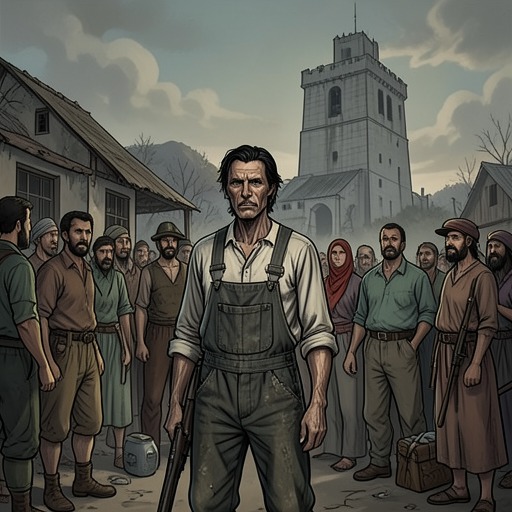
Pasquale Calvi
The Florios of SicilyPasquale Calvi is a revolutionary committed to an independent Sicily, and his clash with Vincenzo Florio gives political defeat a personal voice. When the city’s leaders accept surrender, Calvi rejects their claim that caution was unavoidable: to him, their choice has preserved their own lives and interests by condemning the island and its advocates to submission and exile.
Political Conviction and Revolutionary Context
Calvi belongs to the movement that sought a free Sicily, independent of Bourbon rule and confederated with the Italian states. During the revolution, the Sicilian government sought to revive the 1812 constitution, but the political project lacked a king willing to take the crown, and Britain opposed Sicily’s separation from the Bourbons. The revolutionaries’ cause thus faced resistance not only from the Bourbon state but also from uncertainty over what political settlement could replace it.
Vincenzo’s account of the revolutionary period sets out the pressures surrounding Calvi’s cause. The revolutionary regime requisitioned the steamship company’s vessel Palermo to transport troops; Vincenzo says trade had fallen by half and resents the damage to his businesses. He distinguishes Ruggero Settimo, who believed in the revolution but was willing to reason and mediate, from Calvi, whom he describes as more stubborn even than a republican. For Vincenzo, revolutionary proclamations demanding support from the middle classes compounded the economic losses. Calvi’s later accusation that merchants failed to defend the city therefore lands on a conflict already sharpened by the revolution’s demands on commerce and property.
Confrontation over Surrender
After the revolutionary leaders have fled and Palermo has fallen into disarray, Vincenzo has taken a position in the National Guard, though he says he did not want it and had no choice. He also says he distanced himself from the revolutionary government’s actions and had managed his business without a misstep. That self-account frames the dispute: Vincenzo regards prudence and the preservation of life as reasons to accept the outcome, while Calvi treats the retreat as a political and moral failure.
At a gathering with Vincenzo and aristocrats including Baron Turrisi, Calvi confronts the men he believes have sold the island for a meager return. He refuses the noble title offered in addressing him, insisting that his political convictions reject titles of nobility. He says that he and his companions dreamed of an independent Sicily confederated with the Italian states, and accuses those present of never truly believing in that ideal. The defeat has placed his name on an exile list; he must leave his country, and he holds the men before him responsible for the fate awaiting him and other Sicilians.
Calvi singles out Vincenzo as someone who withdrew when Settimo and Calvi had asked him to help defend Palermo. Vincenzo answers that resistance would have meant getting themselves killed and that surrender spared the city a bloodbath. Baron Turrisi similarly argues that resistance had become impossible after Messina and Catania fell, given the lack of weapons and supplies. Their defense makes surrender a calculation about the lives remaining and the military balance; Calvi refuses to accept that calculation as absolution. To him, it turns the survival of the city’s powerful into the sacrifice of the independence movement.
Exile and the Cost of Defeat
The argument is interrupted by the unrest outside. Stones strike the palace walls, and one lands inside, chipping a floor tile. Calvi points to the shouts from the people of Palermo as evidence that the city does not consent to surrender. The scene sets a material mark of the crisis beside the competing political claims: the palace is no refuge from popular anger, and the decision made within it is contested beyond its walls.
Calvi’s accusation culminates in a curse directed at the men who accepted defeat: the memory of their decision, he says, should keep them awake, and their sons should one day rise against them and blame their cowardice. He runs out while shouts and gunfire shake the city. Turrisi proposes leaving until tempers cool; the others depart without answering the larger charge. Calvi’s exile is not shown as an abstract consequence of political failure but as the immediate personal price of a cause he says the city’s leaders abandoned.
Significance in the Political Conflict
The confrontation places two accounts of responsibility side by side. Vincenzo and Turrisi argue from the limits imposed by military defeat and the human cost of further fighting; Calvi argues from the consequences of yielding political autonomy and leaving committed revolutionaries to face exile. His refusal of an aristocratic title reinforces the distinction between his political ideal and the titled men he accuses of retreating from it. The dispute does not resolve whether resistance could have succeeded. It makes clear, instead, that a surrender defended as the only practical course can still be experienced by its opponents as a betrayal whose consequences outlast the battle.
Calvi’s words also anticipate the continuing strain between the Florios’ commercial interests and Sicily’s political demands. Vincenzo later complains that, during Garibaldi’s occupation, the Bourbons requisitioned three of his five steamers for troop transport, sank one, and then sought to fine him for interrupted mail service. That later grievance echoes the earlier collision between state power and private business, but it does not erase Calvi’s charge: the costs imposed on a merchant and the cost of political defeat are different kinds of loss. In the surrender scene, Calvi insists that the latter will be borne by the island and by those driven into exile.